

























































































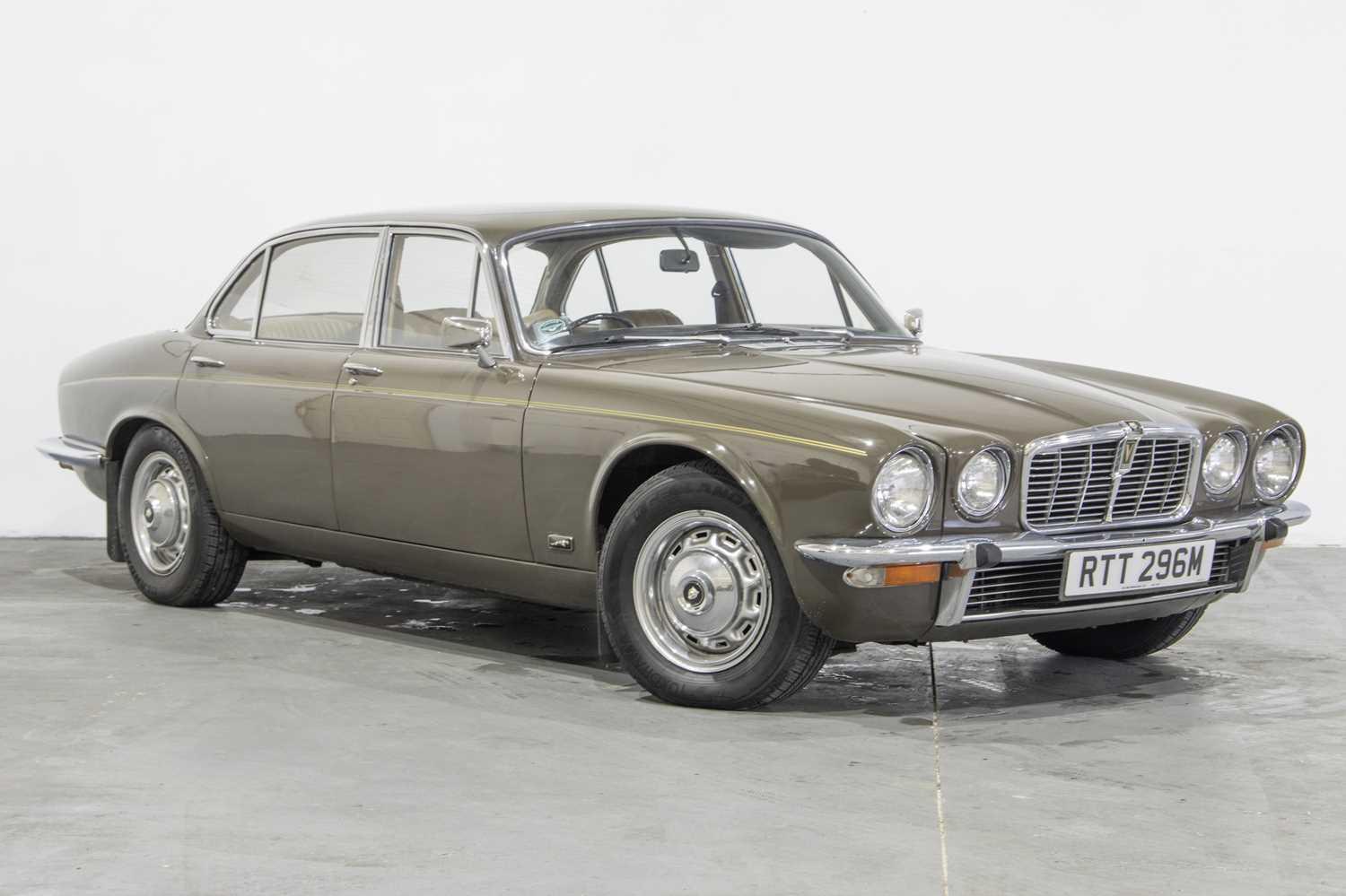
Jaguar introduced the XJ range in September 1968, marking the last saloon to bear the influence of the company’s founder, Sir William Lyons. The ultimate version of the XJ was the XJ12, which offered more pace from its smooth and quiet 5343cc V12, launched in July 1972. At launch, it was the world’s only mass-produced car with twelve cylinders and, with a top speed of around 140 mph, the fastest full four-seater on the market. The XJ was available as a long-wheelbase (L) or standard configuration, however, from 1974, all XJs were offered in a long-wheelbase form only. Anecdotally, it was referred to as ‘The Best Car in the World’.
A Series 2 XJ12 L, this example was first registered on the 1st October 1973, a majestic long-wheelbase V12 iteration of the XJ with 6 former keepers recorded. ‘RTT 296M’ wore its first and exclusive number plate, ‘LVP 42’, for over 36 years, the previous keeper acquiring the XJ12 L in 2022 and has subsequently enjoyed taking it around car meets and shows for the last couple of years. The current keeper has owned it since 2025 and has enjoyed driving the vehicle. Presenting well, for its years, it’s finished in Sable Brown, with a complementing gold pinstripe. Inside, there is the usual luxury you’d expect of the 5.3 litre V12 with tan leather, wood and co-ordinated carpets. This XJ12 L is fitted with the automatic transmission with top-of-the-range driver comforts such as air conditioning, electric windows and power-assisted steering. Showing consideration for the car, the four corners are shod with Yokohama tyres on the XJ's steel rims.
Whilst we have no information regarding any restoration or major work carried out within paperwork, there are approximately 30 invoices for minor maintenance from 1982 through to 1993, such as attention paid to coolant and air conditioning hoses, spark plugs, ball joints and exhaust. Additionally, there is a collection of paper MOTs dating from 1978 until 2015, a wiring diagram for car and air conditioning, a Radiomobile guarantee form signed in 1973, and paperwork which might suggest a previous owner was a member of the Jaguar Enthusiasts Club. There’s also an accompanying Jaguar service book which contains 4 stamped entries, a spare key and a current V5 Registration Document.
The car has recent work carried out: new water pump; repairs to power steering pump and pipework; new distributer; new rotor arm; new spark plug leads; new spark plugs. Invoice are present in the history folder, invoices are from Surrey Jag Centre totalling £3,800.
Contact Us
